
AFFORDABLE FOR WHOM? PIONEER HOUSING HANDOVER IN ELDORET SPARKS DEBATE OVER PRICES
Ruto hands over 2,157 homes in Eldoret, but a viral price list asks: affordable for whom? A look at what the numbers mean for ordinary Kenyans.

Watch Getembe TV Live
Broadcast Getembe TV Live Stream
Listen Getembe FM Live
Tune in to Getembe FM Live Broadcast
As President William Ruto handed over keys to 2,157 homeowners at the Pioneer Affordable Housing Project in Eldoret this weekend, fireworks lit up the sky and officials celebrated a milestone in Kenya’s ambitious housing agenda. The KSh 5.3 billion estate boasts modern blocks, shops, a kindergarten, playgrounds, a clubhouse, and even a swimming pool. On paper, it looks like progress. Online, however, a simple flyer and a pointed question have sparked a sharper conversation.

A widely shared post featuring price lists for Eldoret units under the Boma Yangu platform asked the uncomfortable question many Kenyans are thinking: “Affordable housing isn’t looking so affordable after all… How exactly are mama mboga, boda boda riders, and ordinary Kenyans supposed to afford these houses? Affordable for who, exactly?” The flyer shows social-class bedsitters (20 sqm) priced at KSh 640,000 with a KSh 32,000 deposit and monthly installments of about KSh 3,900. One-bedroom units sit at KSh 960,000 and KSh 5,350 monthly. Higher “affordable” and market categories climb steeply from there.
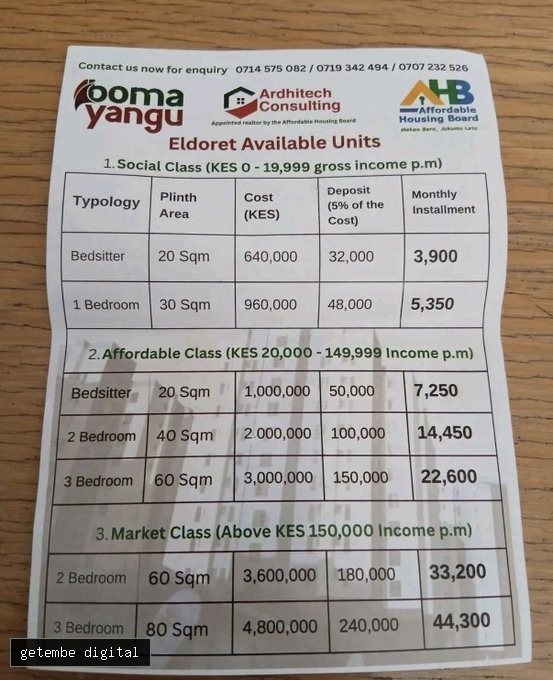
These figures come from the government’s Tenant Purchase Scheme, aimed at households earning under KSh 20,000 a month for the social category. The programme is partly funded by the Affordable Housing Levy a mandatory deduction from formal salaries that has survived court challenges and remains politically contentious. Supporters argue the units represent a genuine step up from informal settlements. A single-room mabati structure in a slum can cost KSh 4,000–5,000 a month in pure rent with no ownership at the end. A modern bedsitter at KSh 3,900 that eventually becomes yours looks, to some, like a solid deal.
Yet the numbers tell a more complicated story when matched against real livelihoods. Many mama mboga (vegetable sellers) report net daily earnings around KSh 1,000–1,200 on good days. Boda boda riders commonly take home KSh 600–1,500 after fuel, maintenance, and stage fees, though gross collections can be higher in busy areas. Consistent monthly income in the KSh 20,000–40,000 range is possible for disciplined operators, but it is far from guaranteed. After food, school fees, transport, and the informal costs of daily life, a fixed KSh 3,900–5,350 installment becomes a heavy commitment. Deposit requirements, even at 5%, can also shut out those living hand-to-mouth.
Critics further note that the units are modest in size a 20 sqm bedsitter is essentially a single room with basic facilities. Moving a family of three or four from a larger (if precarious) informal dwelling into a compact formal unit raises questions about dignity and practicality. At the same time, the programme has delivered tangible economic activity: local Jua Kali artisans supplied thousands of doors and windows, cement and steel came overwhelmingly from Kenyan sources, and construction created jobs. The government points to these multiplier effects and the long-term goal of shifting Kenyans from renters to owners.
Broader challenges persist. Sales and take-up have lagged behind construction targets in some reports, creating financing pressure as the programme relies on both levy collections and unit sales to sustain further building. Political debate remains heated, with opponents questioning the levy’s fairness and demanding greater accountability, while the administration insists the alternative is continued growth of informal settlements.
The Eldoret handover is real achievement in bricks and mortar. The viral concerns are equally real. True affordability is not only about headline prices or amenities; it is about whether the intended beneficiaries the mama mboga who wakes before dawn, the boda rider navigating traffic for every shilling, the informal worker whose income fluctuates can actually step into these homes without trading one form of precariousness for another.
Kenya’s housing push will ultimately be judged not by the number of keys handed over, but by whether ordinary citizens can keep the doors open and eventually call the houses their own. The conversation started by that simple flyer is one the programme cannot afford to ignore.
ADVERTISEMENT
Watch Getembe TV Live
Broadcast Getembe TV Live Stream
Listen Getembe FM Live
Tune in to Getembe FM Live Broadcast
How do you feel about this article?
Let us know by choosing a reaction below.

Written by FRANKLINE NYANDORO
Reporter and staff writer at Getembe News.
Comments 0
Please log in to participate in the comments section.
No comments yet. Be the first to share your thoughts!
ADVERTISEMENT
Related Stories


Have a news tip?
Do you have an investigation, local story or news event you think we should cover? Contact our newsroom directly.
Submit Tip
Mobile App
Download Getembe Digital App Today
Download Getembe Digital App today for live news updates, breaking notifications, and seamless live streaming.