RED BAND AT OBURU ODINGA’S HOSPITAL BIRTHDAY SPARKS QUESTIONS: HERE’S HOW COLOUR CODES WORK
A red wristband seen in photos of Oburu Odinga’s 83rd birthday at Nairobi Hospital has sparked questions about his health. But does the colour signal a critical condition, or is there another explanation?
Watch Getembe TV Live
Broadcast Getembe TV Live Stream
Listen Getembe FM Live
Tune in to Getembe FM Live Broadcast
When photos emerged of veteran Kenyan politician Oburu Odinga celebrating his 83rd birthday at Nairobi Hospital on 15 October 2026, one detail quickly caught public attention: a red wristband on his arm. Amid ongoing health speculation and the emotional weight of the day (which also marked the first anniversary of his brother Raila Odinga’s death), social media users began asking what the red band signified. Was it a sign of critical condition? Many people simply do not know how hospital colour systems work and the confusion is understandable, because the meanings can differ depending on the setting.
Here is a clear guide to the colour-coded triage and identification systems used in hospitals and emergency situations.
The Classic Triage Colour System (Especially Mass Casualty and Field Use)

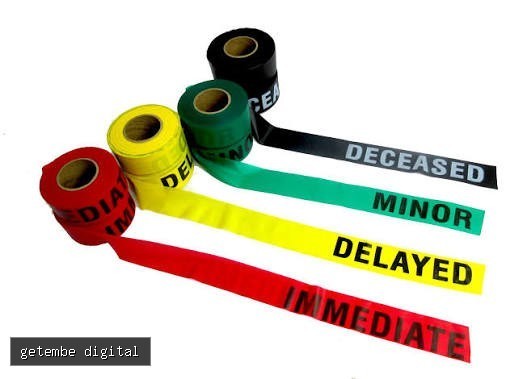
In disaster or mass-casualty incidents, responders use a simple, highly visible colour-tag system (most commonly START Simple Triage and Rapid Treatment) to prioritise care quickly when resources are limited:
- RED (Immediate / Critical): Highest priority. The patient has life-threatening injuries or conditions that are potentially survivable with rapid treatment severe bleeding, difficulty breathing, chest trauma, shock, or unstable vital signs. These patients need care within minutes.
- YELLOW (Delayed / Urgent): Serious injuries that require attention, but the patient is stable enough to wait 30–60 minutes or longer.
- GREEN (Minor / Walking Wounded): Can walk and wait hours if necessary. Minor cuts, sprains, or other non-life-threatening issues.
- BLACK (Deceased / Expectant): Dead, or injuries so severe that survival is unlikely even with full resources. Comfort care may still be provided.
- Some systems add BLUE for expectant/comfort-care-only patients who are still alive but have a very poor prognosis given available resources.
This system is designed for the field or major emergencies so that limited medical teams can do the greatest good for the greatest number.
How Colours Appear Inside Hospitals
Once a patient reaches a hospital emergency department or is admitted, colour coding still plays a role, but it is not always identical to field triage.
Many emergency departments (including facilities in Kenya) use colour codes at triage to decide who is seen first: red or equivalent for immediate life-threatening cases, orange or yellow for urgent, green or blue/white for less urgent. Staff aim to get red-coded patients into resuscitation or treatment areas without delay.
For inpatients, coloured wristbands more often serve as safety alerts rather than pure priority tags. International patient-safety standards (widely followed, including recommendations associated with the American Hospital Association) commonly assign:
- Red → Allergy alert (medication, food, or other). Staff must check the chart before giving anything.
- Yellow → Fall risk.
- Purple → Do Not Resuscitate (DNR) or similar advance directive.
- Other colours may indicate restricted limb use, latex allergy, or other specific risks.
Practices can vary by hospital and country. Nairobi Hospital, for example, has described colour-coding patients in its emergency department (red and blue for immediate attention). Individual facilities decide their exact protocols, so a red wristband does not automatically mean the same thing everywhere.
Why the Confusion Arises
People often mix up the two systems. Seeing a red band in a hospital photo can trigger the association with “red = critical” from disaster triage training or movies. In reality, the band might simply flag an allergy so that every nurse and doctor who interacts with the patient is immediately aware. It could also relate to acuity in some units. Without the hospital’s specific policy and the patient’s full clinical details, outside observers cannot know the exact meaning.
In Oburu Odinga’s case, the birthday photos showed him in a hospital gown surrounded by family and staff, cutting cake and expressing gratitude for the care he was receiving. The visible red wristband prompted online questions and speculation. Such curiosity is natural, but medical privacy and the fact that colour codes are facility-specific mean the public cannot accurately interpret it from a photograph alone.
Why This Knowledge Matters
Understanding these systems helps the public:
- Appreciate why some patients are seen before others in a busy emergency room.
- Recognise that colour tags are tools for safety and prioritisation, not necessarily indicators of the worst possible outcome.
- Avoid spreading unverified assumptions about a person’s health based on a single visual cue.
Triage exists to save lives under pressure. Whether in a mass-casualty scene or a hospital ward, the colours exist so that trained professionals can act fast and correctly. The next time you see a coloured wristband or triage tag, you will know it is part of a deliberate system designed to protect patients even if the precise meaning depends on the context.
ADVERTISEMENT
Watch Getembe TV Live
Broadcast Getembe TV Live Stream
Listen Getembe FM Live
Tune in to Getembe FM Live Broadcast
How do you feel about this article?
Let us know by choosing a reaction below.

Written by FRANKLINE NYANDORO
Reporter and staff writer at Getembe News.
Comments 0
Please log in to participate in the comments section.
No comments yet. Be the first to share your thoughts!
ADVERTISEMENT
Related Stories

Have a news tip?
Do you have an investigation, local story or news event you think we should cover? Contact our newsroom directly.
Submit Tip
Mobile App
Download Getembe Digital App Today
Download Getembe Digital App today for live news updates, breaking notifications, and seamless live streaming.